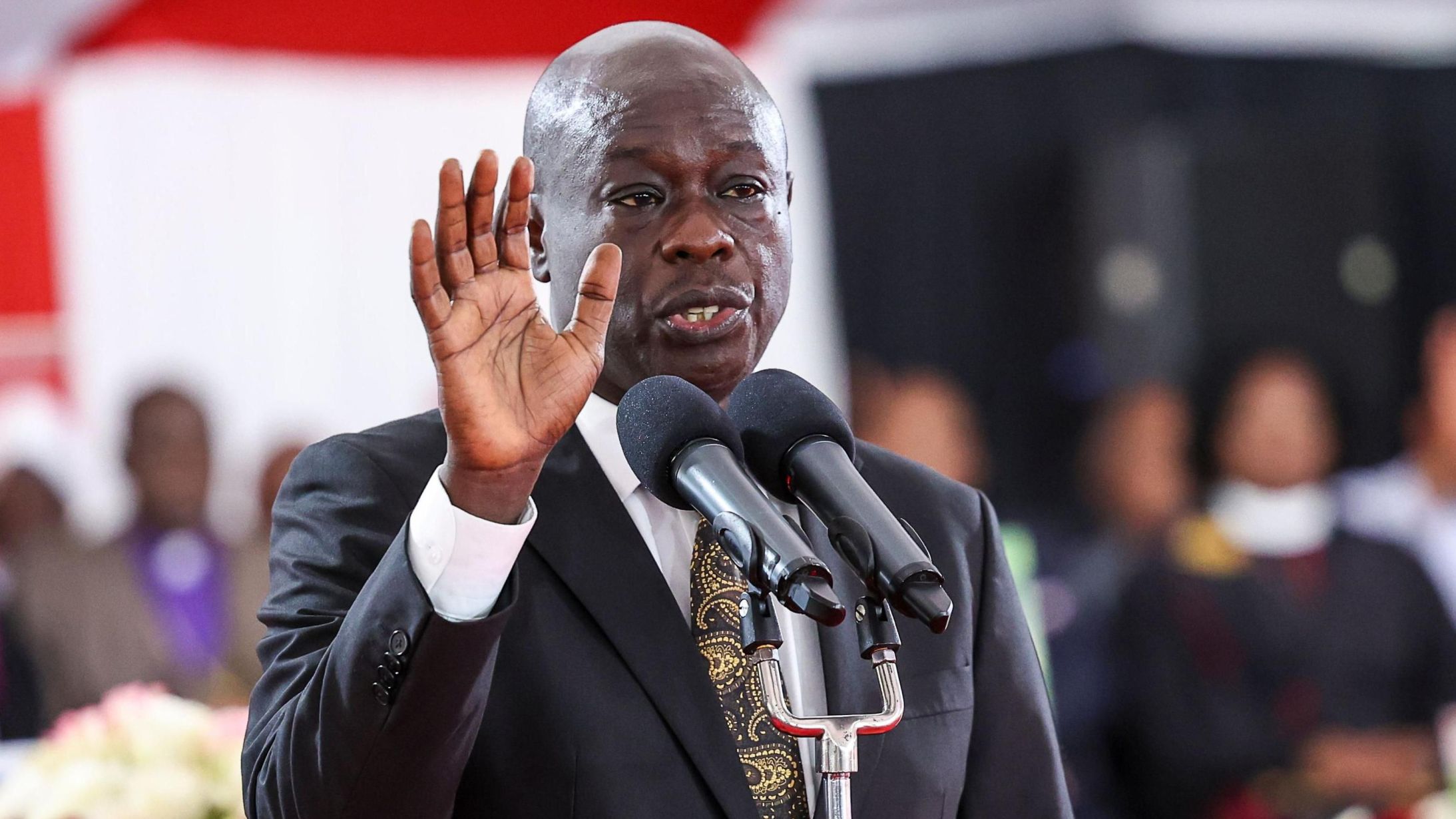
The Supreme Court has refused former Deputy President Rigathi Gachagua’s attempt to suspend impeachment proceedings currently underway in the High Court, affirming that it cannot intervene in cases before lower courts. In a unanimous ruling delivered on Friday, the bench highlighted the limits of its authority and stressed the constitutional hierarchy of Kenya’s judicial system.
The five-judge panel—led by Chief Justice Martha Koome and including Deputy Chief Justice Philomena Mwilu, Justices Smokin Wanjala, Njoki Ndung’u, and Isaac Lenaola—clarified that the Supreme Court may only grant stay orders for cases in the Court of Appeal, not the High Court.
“The Court cannot frog-leap the Court of Appeal to provide relief to a party before the High Court,” the judges stated, referencing Article 163(4) of the Constitution and Section 23A of the Supreme Court Act.
With this ruling, the dispute now returns to the three-judge High Court bench chaired by Justice Eric Ogola, alongside Justices Anthony Mrima and Freidah Mugambi. This panel has previously dismissed multiple attempts by Gachagua to block its hearings.
Gachagua was removed from office in mid-October 2024 following impeachment by the National Assembly, a decision later confirmed by the Senate. His removal sparked legal challenges over the impeachment process, the Deputy Chief Justice’s authority to empanel High Court benches under Article 165(4), and claims of judicial bias.
The main contention has been whether the Ogola-led bench was properly formed to hear multiple petitions arising from his impeachment and the subsequent appointment of Prof. Kithure Kindiki as Deputy President.
High Court dismissals and recusal claims
On October 23, 2024, the High Court dismissed Gachagua’s challenge to Deputy Chief Justice Mwilu’s authority, faulting his lawyers for “playing to the gallery.”
“It is therefore our finding that the constitutional function of the Chief Justice to assign benches, being an administrative function, can be performed by the Deputy Chief Justice when the Chief Justice, for good reason, is unable to perform,” the judges ruled.
The court also rejected claims that it had convened unusually, noting that its electronic Case Tracking System allows urgent matters to be handled outside standard hours.
“There was nothing unconventional in the manner in which this bench dealt with the two applications filed under a certificate of urgency,” the judges said.
The bench criticized attempts to delay proceedings after ex parte orders were obtained under urgency, describing such conduct as “contradictory and undermines the very urgency that the applicants had initially invoked.”
On October 25, the panel also refused to recuse itself, dismissing allegations of bias and conflicts of interest as unsupported. Claims included supposed academic links between Justice Mugambi and Kindiki, appointments involving Justice Ogola’s spouse, and Justice Mrima’s personal associations.
“The application for recusal is hereby disallowed,” Justice Ogola confirmed.
Failed Court of Appeal challenge
Gachagua’s efforts to halt the proceedings at the Court of Appeal also failed. On October 31, a bench led by Justice Patrick Kiage rejected requests for temporary orders to stop the High Court, citing urgency, public interest, and procedural errors by the applicants.
Parallel legal arguments involved presidential immunity and jurisdiction. The Attorney General opposed efforts to involve President William Ruto and argued that challenges to Kindiki’s appointment could only be raised through a presidential election petition in the Supreme Court.
On Friday, the Supreme Court also declined to strike out the National Assembly’s appeal, ruling that issues of judicial estoppel required thorough consideration. It refused to remove contested documents from the appeal record, noting that empanelment directions issued on October 18, 2024, were central to the case.
Similarly, the court rejected the National Assembly’s attempt to strike Gachagua’s cross-appeal, emphasizing that claims on judicial bias and recusal raised constitutional questions addressed by both the High Court and the Court of Appeal.
“There shall be no orders as to costs,” the bench said.
The ruling clears the way for the High Court to proceed with consolidated impeachment petitions, marking a major procedural step in Parliament’s first successful removal of a sitting Deputy President. It also has implications for Gachagua’s political ambitions, particularly in meeting Chapter Six leadership and integrity standards ahead of the 2027 election.